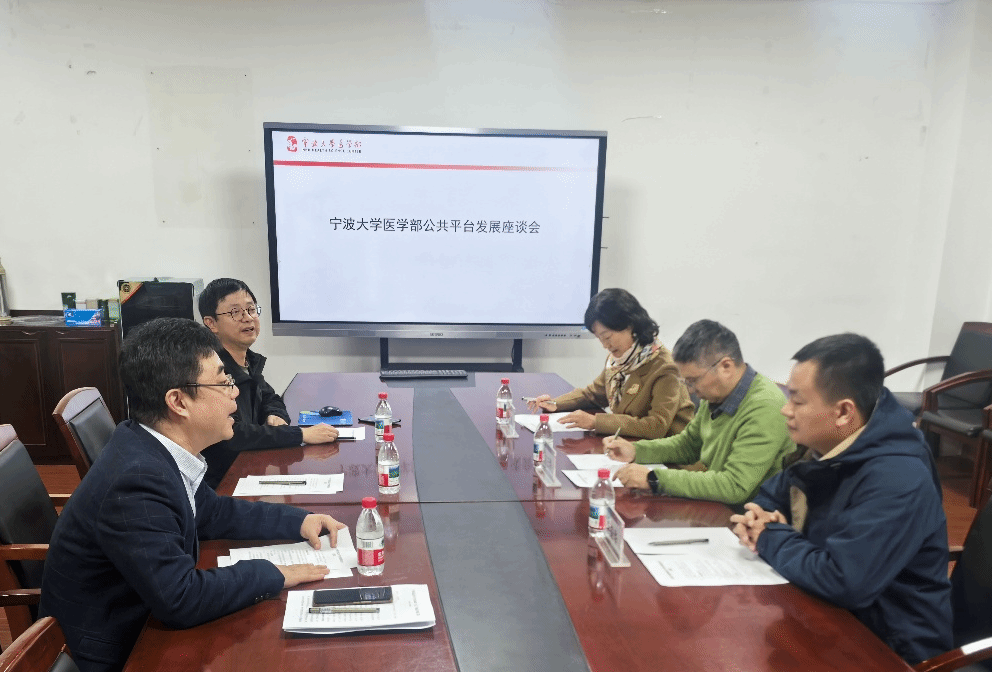
To thoroughly implement the Faculty of Medicine's plan to "strengthen the large-scale instrument public platform and support the recruitment and cultivation of high-level talent," the Faculty of Medicine organized a symposium on the development planning for the large-scale instrument public platform on November 20. The meeting aimed to enhance the attraction and capacity for top-tier talent and innovative teams through the construction of a high-level public instrument platform, laying a solid talent and technological foundation for the high-quality development of the Faculty of Medicine at Ningbo University.
The symposium invited heads of public technology platforms from the School of Medicine at Zhejiang University, the Faculty of Medicine at Soochow University, and the Academy of Chinese Medical Sciences at Zhejiang University of Traditional Chinese Medicine as consulting experts. Fang Ting, a member of the Party Committee of the Faculty of Medicine and the leader in charge of the platform center, Mei Disen, Director of the Platform Center of the Faculty of Medicine, and members of the Experimental Animal Center attended the meeting. Focusing on the theme of "strengthening platform support, pooling talent resources, and empowering disciplinary development," the discussion centered on how the public platform can better support the core mission of talent recruitment and cultivation. The participating experts unanimously agreed that a high-level instrument platform is not only a crucial foundation for disciplinary development but also a key factor in attracting and retaining high-level talent, directly impacting the overall competitiveness of the Faculty of Medicine and the construction of Ningbo's medical innovation system.
Regarding platform planning, experts suggested systematically arranging equipment for imaging, cytology, pathology, and animal platforms based on disciplinary layout and research needs. Priority should be given to configuring versatile and high-utilization advanced instruments to promote functional integration and capacity enhancement, thereby strengthening the appeal to top-tier talent through advanced research conditions. In terms of operational mechanisms, the meeting proposed establishing an efficient and shared service system, improving equipment accessibility and utilization through intelligent reservation systems, training and assessment mechanisms, and cost subsidy policies. Simultaneously, a resource integration mechanism featuring tiered management and internal-external collaboration should be established to promote the centralized management of dispersed equipment and expand the platform's service coverage. Regarding the technical team, the focus was on strengthening the professional and technical personnel team, ensuring the efficient operation of instruments and equipment through scientific management and incentive mechanisms, and providing solid technical support for talent research activities. The meeting also shared advanced experiences from leading universities in platform construction and talent services.
Centering on the development plans for the public platform and the Experimental Animal Center following the completion of the new building at the Faculty of Medicine's main base, the meeting reviewed the comprehensive list of large-scale instrument equipment and clarified the directions for key development and priority equipment introduction. The implementation of this plan will directly support the strengthening of key disciplines and the layout of emerging disciplines within the Faculty of Medicine. By creating an advanced, shared, and efficient research support system, it will significantly enhance the Faculty's core competitiveness and capacity in attracting high-level talent, providing key platform support for building a high-level medical disciplinary system and a talent hub.